

PRP Pain Injections in Vista, CA
Platelet-Rich Plasma therapy — regenerative pain relief without surgery.
Your Body Already Has What It Needs to Heal — We Just Activate It
Chronic pain has a way of becoming the background noise of your entire life. It changes how you move, how you sleep, how you work, and how you show up for the people you care about. You have probably tried anti-inflammatory medications that only go so far. Maybe cortisone shots that worked for a while and then stopped. Maybe physical therapy that helped but never fully resolved the underlying problem. And at some point someone may have mentioned surgery — a conversation you are not ready to have.
There is a step most patients never get offered between cortisone shots and surgery. That step is PRP.
Platelet-Rich Plasma therapy is one of the most exciting advances in regenerative medicine of the last two decades. Instead of masking your pain with medication or cutting into the problem with surgery, PRP uses the concentrated healing power already present in your own blood to repair damaged tissue, reduce inflammation, accelerate recovery, and deliver long-lasting pain relief that targets the actual source of your problem — not just the symptom.
At Oasis Medical Group in Vista, California, Dr. Kareem Moasis, MD, and his team offer physician-supervised PRP pain injections for patients dealing with joint pain, tendon injuries, muscle damage, sports injuries, back pain, sciatica, and chronic inflammation. If you are tired of temporary fixes and ready for a treatment that works with your body rather than around it — PRP at Oasis may be exactly what you have been looking for.
PRP Treatment Guide
Review our PRP treatment overview below, or download a copy to read offline and share with family members helping you make care decisions.
PRP Treatment Overview
Tap or click the image to view full size
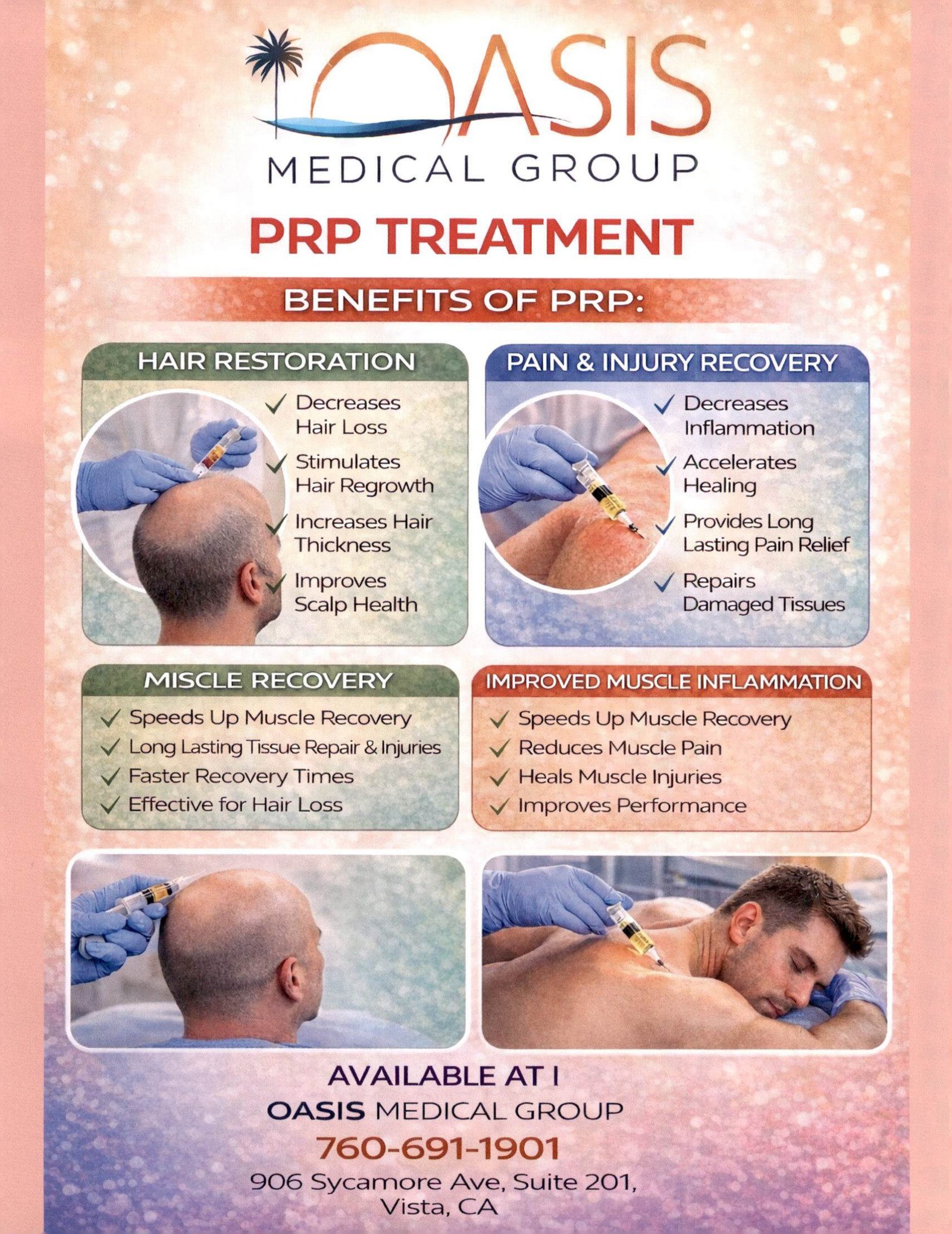
What Is PRP Therapy for Pain?
Platelet-Rich Plasma therapy is a regenerative medical treatment that concentrates the natural healing agents found in your own blood and delivers them directly to the site of pain or injury — dramatically accelerating the body's natural repair process and providing meaningful, lasting relief.
Your blood contains four main components — red blood cells, white blood cells, platelets, and plasma. Platelets are tiny cells best known for their role in clotting, but they carry something far more powerful for healing — an extraordinary concentration of growth factors. These include platelet-derived growth factor (PDGF), vascular endothelial growth factor (VEGF), transforming growth factor beta (TGF-β), insulin-like growth factor (IGF), and fibroblast growth factor (FGF). Together these growth factors orchestrate the body's repair response — stimulating cell proliferation, new blood vessel formation, collagen synthesis, and tissue regeneration.
In areas of chronic pain and injury — tendons, joints, spinal structures, and muscle tissue — blood supply is often limited and the natural healing process stalls. Degenerated cartilage, chronically inflamed tendons, and damaged joint tissue lack the growth factor concentration needed to complete proper repair. PRP solves this problem by delivering a concentrated dose of exactly the biological signals the tissue needs to heal directly to the site of damage.
The result is reduced inflammation, accelerated tissue repair, and pain relief that does not just mask the problem — it addresses its biological root.
Conditions We Treat With PRP Pain Injections
PRP pain injections at Oasis are used to treat a broad range of musculoskeletal pain conditions:
Joint Pain
- •Knee osteoarthritis — one of the most common and well-studied applications of PRP
- •Hip joint degeneration and arthritis
- •Shoulder joint pain and rotator cuff conditions
- •Ankle and wrist joint pain
- •Finger and toe joint arthritis
Tendon Injuries and Tendinopathy
- •Patellar tendinitis — jumper's knee
- •Achilles tendinopathy — one of the most responsive conditions to PRP
- •Lateral epicondylitis — tennis elbow
- •Medial epicondylitis — golfer's elbow
- •Rotator cuff tendinopathy
- •Plantar fasciitis — heel pain
- •Hamstring tendinopathy
Muscle Injuries and Recovery
- •Chronic muscle strains and partial tears
- •Sports-related muscle injuries
- •Accelerated recovery from acute muscle damage
- •Muscle inflammation and performance-limiting pain
Spine and Back Pain
- •Sciatica and lumbar radiculopathy
- •Sacroiliac joint dysfunction
- •Facet joint pain
- •Lumbar disc-related pain
- •Chronic lower back pain not responding to conventional treatment
Bursitis
- •Trochanteric bursitis — hip bursitis
- •Subacromial bursitis — shoulder bursitis
- •Pes anserine bursitis — inner knee bursitis
- •Olecranon bursitis — elbow bursitis
Post-Surgical Recovery
- •Accelerating healing following orthopedic procedures
- •Reducing post-surgical inflammation and pain
- •Improving outcomes after ligament and tendon repairs
The Four Key Benefits of PRP for Pain
Based on clinical research and the experience of patients at Oasis, PRP pain injections consistently deliver four primary therapeutic benefits:
Decreases Inflammation
Chronic pain is almost always driven by persistent inflammation at the tissue level. PRP delivers anti-inflammatory growth factors directly to the inflamed area — reducing the inflammatory cascade that perpetuates pain more effectively and more durably than corticosteroid injections, which provide temporary relief without addressing the underlying biology.
Accelerates Healing
The growth factors in PRP directly stimulate the cellular processes responsible for tissue repair — including collagen synthesis, fibroblast proliferation, and new blood vessel formation. This accelerates healing of damaged tendons, cartilage, and muscle tissue at a biological level rather than simply managing symptoms.
Provides Long-Lasting Pain Relief
Unlike cortisone injections that typically provide relief for weeks to months before requiring repeat treatment, PRP promotes actual tissue repair — meaning the pain relief it produces is tied to genuine biological improvement in the treated tissue. Many patients experience meaningful relief that lasts twelve to eighteen months or longer from a single treatment series.
Repairs Damaged Tissue
This is what truly distinguishes PRP from conventional pain management. Cortisone reduces inflammation temporarily but can actually weaken tissue with repeated use. PRP actively promotes the regeneration of damaged cartilage, tendon, and muscle tissue — rebuilding the structural integrity of the area rather than just quieting the pain signal.
How PRP Pain Injections Work at Oasis
Step 1 — Comprehensive Pain Evaluation
Before any PRP treatment begins, Dr. Moasis and his team conduct a thorough evaluation of your pain condition. He reviews your history, examines the affected area, reviews any relevant imaging you have, and determines whether PRP is the appropriate treatment for your specific diagnosis. Not every pain condition is best treated with PRP — Dr. Moasis and his team will give you an honest assessment of whether it is right for you.
Step 2 — Blood Draw
On the day of your PRP session a small amount of blood — typically 20–60ml depending on the treatment area — is drawn from your arm. This is a simple, quick procedure comparable to a standard blood draw and takes only a few minutes.
Step 3 — PRP Preparation
Your blood sample is placed in a specialized centrifuge and spun at precisely calibrated speeds to separate the blood components and concentrate the platelets and growth factors. This process takes approximately 10–15 minutes and produces a concentrated PRP solution with platelet levels significantly higher than normal blood — typically five to ten times the baseline concentration.
Step 4 — Treatment Area Preparation
The injection site is cleaned and prepared. Depending on the location and your comfort level, a local anesthetic may be applied to minimize discomfort during the injection. Many injections are performed with ultrasound guidance to ensure precise placement of the PRP directly into the target tissue.
Step 5 — PRP Injection
Dr. Moasis and his team inject the concentrated PRP directly into the damaged or painful tissue using precise technique. The entire injection process typically takes 10–20 minutes. Some patients experience a temporary increase in discomfort at the injection site in the 24–72 hours following treatment — this is a normal part of the inflammatory healing response that PRP triggers and is a positive sign that the biological repair process has been activated.
Step 6 — Post-Treatment Care
Dr. Moasis and his team provide specific aftercare instructions including activity modifications, icing protocols, and guidance on when to resume normal activities and exercise. Most patients can return to light daily activities the same day. More strenuous activity is typically restricted for a short period to allow the healing response to establish properly.
Step 7 — Follow-Up and Additional Sessions
PRP for pain typically requires a series of one to three injections spaced four to six weeks apart for optimal results. Dr. Moasis and his team evaluate your response after each session and determine the appropriate number of treatments based on your condition and progress. Some patients achieve their goals with a single injection — others benefit from a full series.
What Results Can You Expect?
Setting realistic expectations is critical to a satisfying PRP experience. Here is the honest picture of what patients at Oasis experience:
Timeline of Results
Days 1–3
Some patients experience increased soreness at the injection site as the inflammatory healing response activates. This is expected and temporary.
Weeks 1–4
Early reduction in baseline inflammation. Some patients begin noticing reduced pain and improved function within the first few weeks.
Months 1–3
Progressive tissue healing. Pain levels continue to improve as damaged tissue undergoes repair and regeneration stimulated by the growth factors.
Months 3–6
Full results of the treatment series develop. Most patients who respond to PRP achieve their maximum benefit within three to six months of their final session.
Realistic Outcomes
- ✓Significant and lasting reduction in pain levels
- ✓Improved joint function and range of motion
- ✓Reduced dependence on anti-inflammatory medications
- ✓Faster return to exercise and physical activity
- ✓Delayed or avoided need for surgical intervention
- ✓Improved muscle performance and recovery
Who Responds Best
Patients with mild to moderate joint degeneration, tendinopathy, and muscle injuries tend to respond most consistently to PRP. Patients with severe end-stage arthritis where cartilage is entirely absent may not achieve the same benefit — Dr. Moasis and his team will advise you honestly on whether PRP is likely to be effective for the severity of your condition.
PRP vs Cortisone Injections — What Is the Difference?
This is one of the most common questions patients ask — and it deserves a clear, honest answer.
For many patients the ideal approach is to use a cortisone injection for immediate relief while PRP does the deeper regenerative work. Dr. Moasis and his team will discuss whether a combined approach makes sense for your situation.
How It Works
Cortisone Injections
Cortisone is a powerful anti-inflammatory steroid that reduces pain and swelling quickly — often within days. It suppresses the inflammatory response without repairing what caused it.
PRP Injections
PRP takes longer to produce results because the healing process it stimulates is biological and takes time. But PRP actively repairs the damaged tissue that is causing the pain.
Effect on Tissue
Cortisone Injections
Repeated cortisone injections can weaken tendons, degrade cartilage, and mask pain while allowing underlying damage to progress.
PRP Injections
PRP strengthens tendons rather than weakening them. It stimulates cartilage repair rather than degrading it. Relief is tied to actual structural improvement.
Duration of Relief
Cortisone Injections
Relief typically lasts weeks to months and often diminishes with repeated injections.
PRP Injections
Many patients experience meaningful relief lasting twelve to eighteen months or longer from a single treatment series when tissue repair is achieved.
Best Use
Cortisone Injections
Effective for short-term relief and appropriate in certain situations — but not a long-term regenerative solution on its own.
PRP Injections
Ideal for patients seeking durable relief by addressing the biological root of chronic joint, tendon, and muscle pain.
PRP for Muscle Recovery and Performance
Beyond treating established pain conditions, PRP is increasingly used by active patients and athletes for accelerated muscle recovery and injury prevention. The growth factors in PRP speed up muscle repair following intense training, reduce muscle inflammation that limits performance, heal partial muscle tears that would otherwise require extended rest, and improve the structural resilience of muscle tissue against future injury.
Patients who use PRP for muscle recovery and performance at Oasis include weekend athletes dealing with recurring soft tissue injuries, active adults who want to maintain their training without being sidelined, and patients recovering from sports injuries who want to return to activity as quickly and safely as possible.
If you are an active person whose quality of life depends on being able to move without pain — PRP is worth a serious conversation with Dr. Moasis and his team.
Why Choose Oasis Medical Group for PRP Pain Injections in Vista
Physician-Supervised Treatment
PRP pain injections at Oasis are performed and supervised by Dr. Moasis and his team directly. The quality of your PRP preparation, the precision of injection placement, and the monitoring of your response are all managed by a board-certified physician with specialized training in regenerative medicine and pain management.
Integrated Pain Management
PRP at Oasis does not happen in isolation. Dr. Moasis and his team evaluate your full health picture — including contributing factors like hormonal imbalances, nutritional deficiencies, and systemic inflammation — and incorporate PRP into a comprehensive pain management strategy designed to address your condition from multiple angles.
Honest Assessment
Dr. Moasis and his team will not recommend PRP if it is not appropriate for your condition. If your pain is better served by a different treatment — or if the severity of your condition makes PRP unlikely to be effective — he will tell you that clearly and discuss what alternatives make more sense for your situation.
Transparent Cash-Pay Pricing
PRP pain injections are typically not covered by insurance and are offered at transparent, competitive cash-pay pricing at Oasis. Package pricing for treatment series is available. Call 760-691-1901 for current pricing.
Conveniently Located in Vista, CA
Located at 906 Sycamore Ave, Suite 201 in Vista — serving patients from Oceanside, Carlsbad, San Marcos, Escondido, Encinitas, Fallbrook, and all of North County San Diego.
What to Expect at Your PRP Pain Consultation
Your initial PRP pain consultation with Dr. Moasis and his team runs approximately 30–45 minutes. He will evaluate your pain condition, review any relevant imaging, assess whether PRP is the appropriate treatment for your situation, and outline a realistic treatment protocol and expected outcomes.
Come prepared with:
- Any X-rays, MRI, or ultrasound imaging related to your pain condition
- A description of your pain — location, duration, severity, what makes it better or worse
- A list of treatments you have already tried and their results
- Your current medications and any known allergies
- Your questions — there are no wrong ones
There is no pressure at your consultation. Dr. Moasis and his team give you an honest picture of what PRP can realistically achieve for your specific condition and what the process involves. The decision to proceed is entirely yours.
Frequently Asked Questions
The number of sessions depends on your condition, its severity, and your response to treatment. Most patients receive one to three injections spaced four to six weeks apart as an initial series. Some conditions — particularly mild to moderate tendinopathy — respond well to a single injection. Dr. Moasis and his team evaluate your response after each session and recommend additional treatment only when clinically appropriate.
Clinical studies and patient experience at Oasis show that PRP pain relief typically lasts twelve to eighteen months or longer in responsive patients. Because PRP promotes actual tissue repair rather than just suppressing inflammation, results tend to be more durable than cortisone injections. Maintenance injections can be performed as needed if symptoms begin to recur.
The injection process is well tolerated by most patients. Local anesthesia is used at the injection site to minimize discomfort. Most patients experience a pressure sensation during the injection rather than sharp pain. In the 24–72 hours following treatment some soreness at the injection site is normal and expected — it reflects the healing response being activated rather than a problem with the treatment.
For many patients — yes. PRP has helped a significant number of patients with knee arthritis, rotator cuff injuries, tennis elbow, plantar fasciitis, and other conditions avoid or significantly delay surgical intervention. Dr. Moasis and his team will give you an honest assessment of whether your condition is likely to respond well enough to PRP to make surgery unnecessary.
PRP injections for musculoskeletal pain are not typically covered by most insurance plans and are offered on a cash-pay basis at Oasis. Call 760-691-1901 for current pricing and available package options.
Yes — and combination approaches often produce superior results. PRP is commonly combined with physical therapy, Decadron injections for acute flare management, ketamine therapy for central sensitization, and lifestyle interventions including anti-inflammatory nutrition and exercise modification. Dr. Moasis and his team design a comprehensive pain management strategy that uses PRP as part of a broader approach when appropriate.
Stop Living Around Your Pain — Start Treating It
Same-day consultations available. Physician-supervised PRP pain injections in Vista, CA — regenerative, effective, no surgery required.
- 906 Sycamore Ave, Suite 201, Vista, CA 92081
- Monday–Friday 8:00 AM–5:00 PM